(7 minute read)
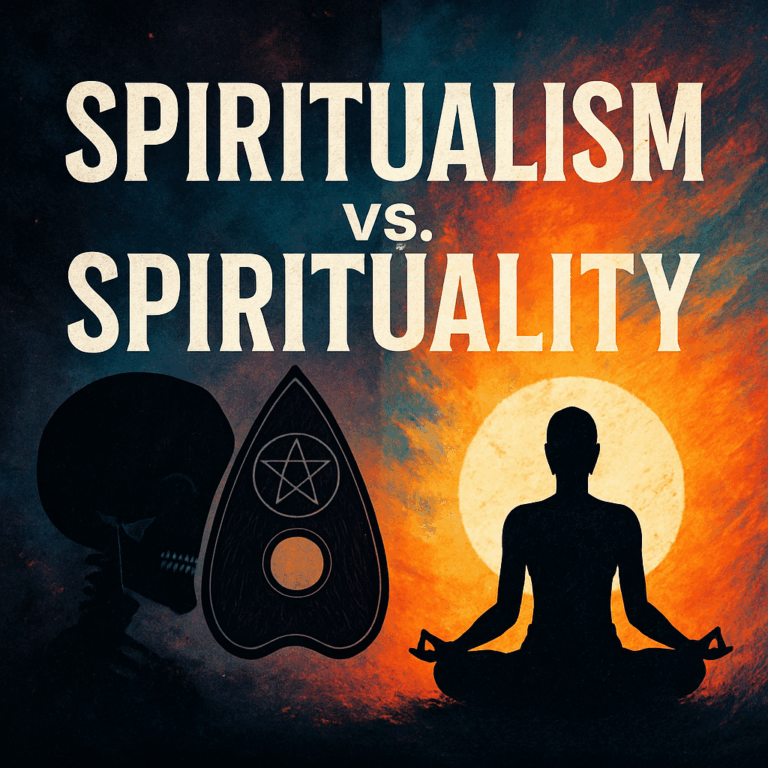
There are many pathways on the healing journey explored throughout the Nourishment Hub, yet few are more vital than discerning the distinction between spirituality and spiritualism. This exploration marks the first of many entries in this theme, as wellness, holistic health, inner work, and even consciousness itself have increasingly been co-opted and used to become more productive workers, to manage stress, or to reinforce spiritual identities rather than dissolve them and tap into the fabric that unites all forms of life.
At its core, the purpose of spiritual development is liberation: to become more free in this experience—within your body, your mind, your energy, and your life—and to align fully with what God created you to be. Without this clarity, we risk mistaking tools for truth, and unknowingly walking a path of service to self, rather than a path of service to Source. This is where the real inquiry begins: what is spiritualism, and how does it differ from true spirituality?
But before we begin, ask yourself this: “Is my path freeing me… or anchoring me to more ideas and concepts about myself or life?”
This article isn’t here to judge or shame, but to bring compassionate clarity to the difference between looking spiritual and truly becoming more whole.
My Personal Journey has Brought Me Through the Lowest Valleys and Highest Peaks
I was blessed to be humbled early in life shortly after turning 18, which catalyzed my spiritual path and conscious self-inquiry fully at 19. Still, even with that initiation, I’ve walked both roads on this inner journey. I’ve had seasons where my practices felt polished and routines dialed in, but there was still a disconnect. I was refining my spiritual toolbelt, but something within me remained out of sync. Parts of my character were still lagging behind the sacred moments I’d been shown. Glimpses of a deeper truth of what’s possible when we live in full alignment and are fully connected to Source and in turn life itself. My heart ached to embody that radiance fully.
Most dangerously, I was still in service to myself: to the version of me I thought I should be, rather than the one I was being called to become.
The deeper I looked, the more I saw the truth: I hadn’t been building trust with God. I fundamentally could give love and experience spiritual happenings that are often written about in sacred texts, but the bridge to fully receive love remained blocked. I didn’t fully trust life or even myself. I was subconsciously building a spiritual identity to shield me from the vulnerability of my deepest wounds purely because I had stopped digging into my own being, stopped embodying the very spiritual truths I lived and knew to be real. I was embodying these spiritual experiences and Truths with conditions based upon my own desires, and not Creators.
It wasn’t until I stripped it all back, until I truly embodied my journey and honored what I’ve been graced to experience that I fell in love again and entered into this next phase of unfoldment. With Source. With life. With myself. And began to build up my intimacy and relationship with Our Creator. Which brings us to the main distinction between spirituality and spiritualism: being in service to the self, or in service to our Creator.
Spirituality is a Path of Return
It is a refining and reorienting toward truth, an infinite onion being peeled layer after layer, a quiet inner looking that brings us back into intimacy with God (Creator, Source, Universal Consciousness, however you name the Divine). It’s the remembrance that we are spiritual beings having a human experience, not the other way around.
This path is one of healing and revealing. It asks us to shed the false, the temporary, the performative so we can rediscover the eternal ground of our being. Unlike beliefs, identities, or external roles, it’s something no one can take from us. And as we walk it sincerely, something begins to happen: we start radiating the unique expression that we were created to be.
Understanding this Path is through the Image of the Rider and the Horse
First, we must recognize and affirm our position, that we are not the horse (the body, the emotions, the thoughts, the conditionings), but the rider (consciousness, will, spirit, and soul). Then, we learn to care for the horse by healing its wounds and earning back its trust. Since we are disconnected from what Creator wants from us, we all naturally put our horses through immense pain and suffering, delusion and heart ache. So it’s a trust that we have to earn back. The horse’s role is to protect the spirit and soul until it is mature enough to begin the spiritual path. Finally, we enter harmony: rider and horse moving as one. This union is where our power lies and serves as another foundation to fully bringing out the fullness of what we were created to be.
And from that place of integration, we begin to align more fully with God, not just through belief, but through being. We begin to trust life again. Trust ourselves. Trust that we are carried, held, and connected and only from there, can we live the liberated life that spirituality has been pointing towards.
Spiritualism, on the other hand, Tends to Center around External Experiences that Reinforce what is Familiar or Comfortable
While it may involve practices that look or feel spiritual, and sometimes even catalyze moments of insight—the focus is often less about communion with God and more about enhancing the personal experience of the self. It’s an outward path dressed in spiritual clothing: seeking pleasure, power, or identity through tools, rituals, or altered states, rather than using those experiences to deepen surrender and alignment.
The energetics of spiritualism are vastly different from the path of spirituality. Where spirituality is a stripping away, a sacred refinement, spiritualism is often a layering on: of more ideas, more aesthetics, more identity, concepts, and experiences. It builds from the outside in, rather than from the inside out.
To return to the earlier metaphor, spiritualism is a path that keeps feeding the horse: strengthening the animal instincts, emotional highs, and ego structures. But no matter how beautifully the horse is dressed, it cannot lead you home. Thus, the chaos often increases in the lives of this lifestyle, for the tools gained only empower the horse, and even when the rider gains knowledge, they’re still not fully under control of how the horse rides. Without alignment with the rider, your spirit and soul, it keeps you bound to the loops of personhood, chasing freedom but never arriving.
At the core, the distinction isn’t about “right or wrong” practices, but orientation and most importantly: intention. Are we using tools to serve our ego’s evolution? Or to deepen our devotion? Are we seeking to appear healed? Or to truly become whole?
The spiritual path is not linear, nor is it free of paradox. But one thing remains consistent: when the aim is union with Source, there is a humbling, a softening, a quiet power that doesn’t need to be seen, only lived. It’s where knowledge becomes experiential wisdom, and the journey of life becomes harmonious. This is the first of many explorations with many more planned to come. May it serve as a mirror, a doorway, or a spark—wherever you are on your path.
“Spirituality is about discovering what you’re not and relearning what you’ve always been. All to reconnect to what unites everything in life.” – P.A.Lucas
An Invitation for Experiential Knowing
If you feel called, I invite you to spend the next few days noticing:
Are your practices feeding the horse or the rider?
Is your path freeing you or fastening you to more ideas and concepts about yourself?
Remove one spiritual “tool” you rely on. Just for a moment.
What’s left in the silence? What still feels sacred when no one else sees it?
If this stirred something in you, sit with it. Let it echo.
Share this with someone who’s on the path—not to fix them, but to walk beside them. The world doesn’t need more spiritual performers. It needs more real, surrendered, and connected people.
Start there. Share this insight. And keep looking in.
Key Takeaways
Spirituality is a return home to Source. Spiritualism often becomes a spiritualized version of ego.
One refines; the other reinforces.This distinction is not judgment—it’s invitation.
True healing begins with humble honesty.
Reflection or Journal Prompt
Where in my life am I using “spiritual tools” to protect my sense of identity, rather than to transform it?